


The market remains gripped by extreme fear. Many Bitcoin investors focus only on short-term price fluctuations and fixate on negative factors. As a result, they overlook strong underlying fundamentals.
Although the price may be correcting, the following data reinforces the case for a recovery.
Lightning Network Growth Despite a Sharp Bitcoin Price Decline
Bitcoin’s price has fallen sharply. However, its use as a payment network has reached an all-time high, as reflected in breakthrough data from the Lightning Network.
The Lightning Network is a Layer 2 protocol built on top of Bitcoin. It enables scalable, low-cost, and near-instant transactions, making it ideal for everyday payments.
Data from Newhedge shows that Bitcoin Lightning Network capacity rose to a record high of 5,800 BTC in December. It remained above 5,600 BTC in early 2026.

Capacity (blue) represents the total amount of Bitcoin locked in Lightning Network payment channels. For the Lightning Network to function, participants must commit BTC to channels in advance. This committed BTC forms the network’s capacity.
Therefore, capacity determines the total value that can be transacted through the Lightning Network at any given time. An increase signals improvements in scalability, reliability, and user adoption.
In addition, a recent report from River revealed that the Lightning Network surpassed $1 billion in monthly transaction volume for the first time. It processed 5.22 million transactions. This growth indicates that businesses and exchanges are using Lightning to move real funds.
“While everyone is focused on Bitcoin dropping to $63K, something happened last week that nobody talked about. The Lightning Network crossed $1 billion in monthly transaction volume for the first time ever… Businesses are using it,” said Fernando Nikolić, a developer at Perception.
Sam Wouters, Director of Marketing at River, explained that most transactions involve transfers between exchanges, often with large amounts. He predicted that in the future, the emergence of AI agents could reduce the average transaction size when executing many small transactions.
Hashrate Recovery Reflects Renewed Miner Confidence
Second, Bitcoin’s hashrate—an important metric that measures the network’s total computational power—has recovered to levels equivalent to September last year, when BTC traded above $100,000.
The strong V-shaped recovery in February shows that miners have returned with renewed confidence. It also strengthens the network’s security and resilience.

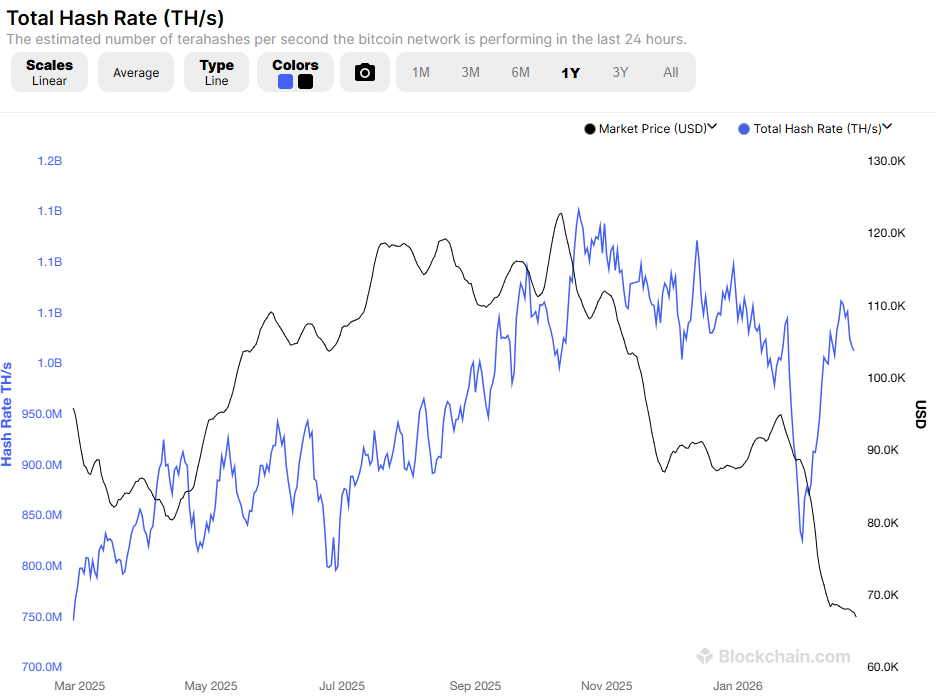
Miners appear to have moved past extreme negative sentiment. They have restarted operations after severe weather disruptions earlier in the year.
Historically, hashrate tends to rise alongside Bitcoin’s price. This pattern often signals a potential recovery in BTC.
The Sign of Strengthening Demand From US Investors
Third, the Coinbase Premium Index turned positive again in the final week of the month after remaining negative for a full month.
The Coinbase Premium Index measures the price difference between Bitcoin on Coinbase and on Binance. A return to positive territory reflects that US investors are willing to buy BTC at higher prices.

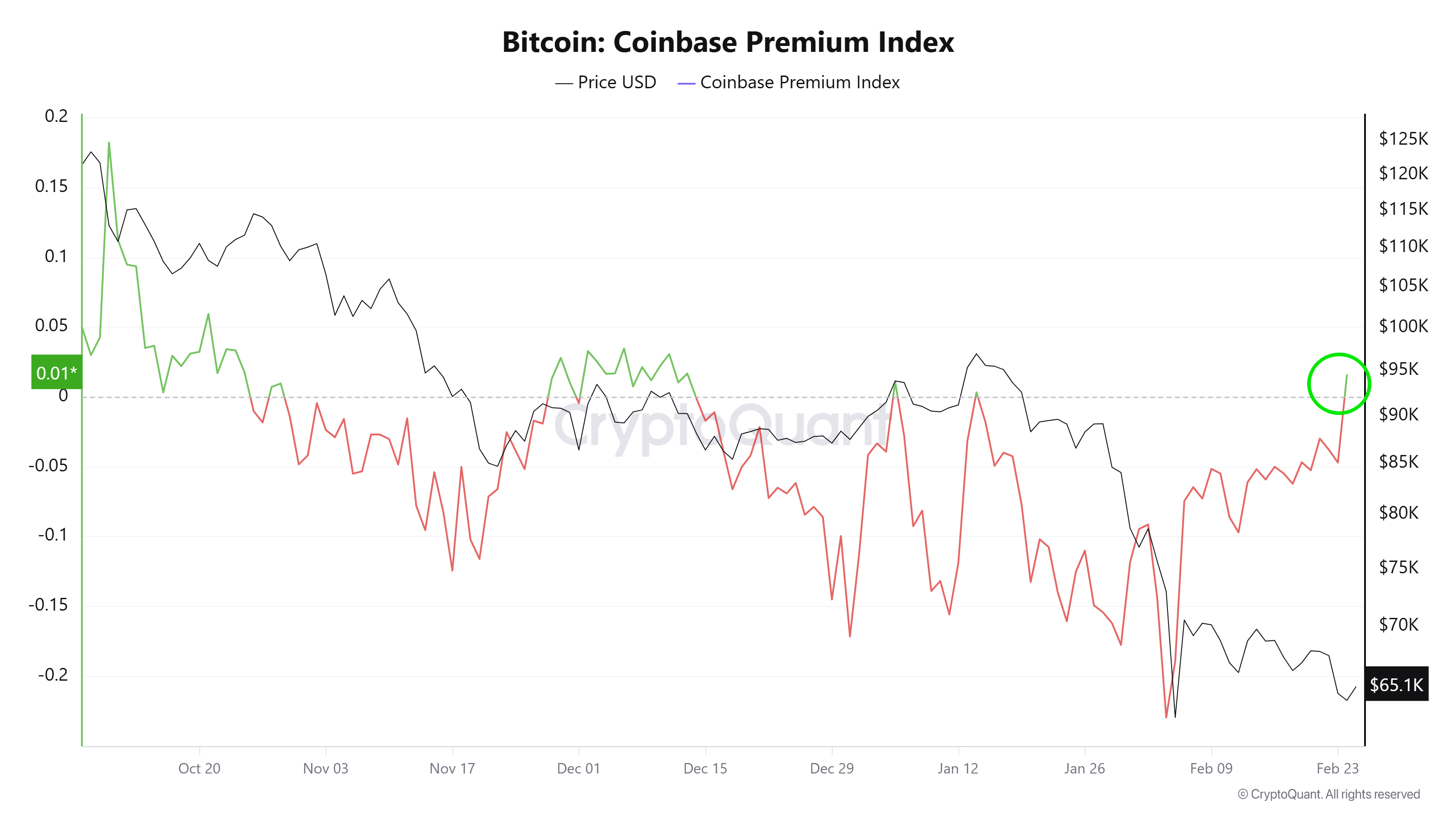
“This return to positive territory suggests a gradual improvement in demand from professional and institutional participants, particularly those based in the United States. This signal remains tentative and reflects ongoing investor caution. However, current price levels appear to be gradually becoming attractive again for professional participants,” commented Darkfost, an analyst at CryptoQuant.
These positive signals may appear faint amid prevailing pessimism. However, they could act as catalysts for a recovery.
Recent analysis from BeInCrypto emphasized that a breakout above the $67,394 resistance level would improve the negative short-term price structure. Such a move would lay the foundation for further upside.




Kommentar hinterlassen